For years, hashtags were the golden ticket to getting discovered on Instagram. Every post ended with a block of 30 hashtags that looked more like a grocery list than a caption. If you’ve been doing the same, I have good news: you can stop.
Today, Instagram SEO versus hashtags isn’t really a debate. Instagram has evolved into a search engine, and so has the way people use it. Instead of scrolling endlessly through hashtag pages, users search for exactly what they want.
Your job isn’t to guess which hashtag will magically boost your reach. It’s to make your content easy for both Instagram and Google to understand.
Here’s how to use SEO on social media so your brand shows up when people are actively looking for what you offer.
Instagram SEO versus hashtags: it matters NOW
Instagram has become much better at understanding context. The platform analyzes your captions, your profile, the text inside your images and videos, your alt text, and even the words you say in reels.
That means keywords carry a lot more weight than stuffing a caption with generic hashtags.
Think about how you search online. You don’t type “#marketingtips.” You search “how to grow on Instagram” or “social media marketing tips for small businesses.” Your audience does the same thing inside Instagram.
If your content answers those searches, you’re giving yourself more opportunities to be discovered without relying on hashtags alone.

1. Write captions like mini blog posts
One of the easiest Instagram SEO tips you can implement today is treating your caption like a piece of searchable content.
Instead of opening with something vague like:
New listing just dropped ✨🏡
Lead with what someone would actually search.
For example:
Modern two-bedroom condo in Brooklyn Heights with skyline views under $1M.
Do you see the difference? The first one was okay in 2015, the second one is what you need to be doing now. More specificity, more strategy, less wishful thinking.
Instagram indexes your captions, and Google can also pull snippets from public posts. Placing your most important keywords within the first 125 characters gives both platforms immediate context about your content.
This doesn’ t mean you’re now writing for a machine. At least, not entirely. People are still at the center. The vector has simply changed. So:
Write for humans first, algorithms second.
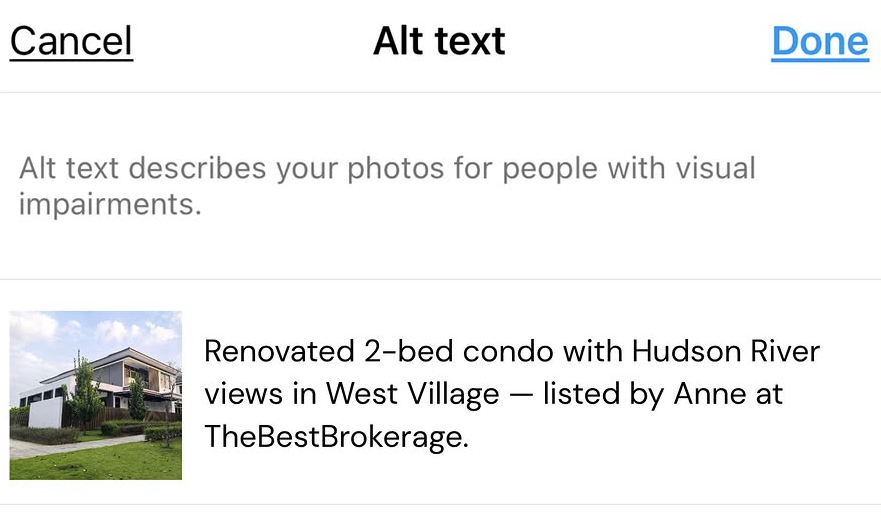
2. Fill out your alt text every single time
The custom alt text field might be one of Instagram’s most underused SEO features.
Originally designed for accessibility, alt text also helps search engines understand what’s actually happening in your content. Think of it like the meta description for your image.
Instead of writing:
Beautiful home.
Do something more descriptive:
Renovated two-bedroom condo with Hudson River views in Manhattan listed by a New York real estate agent.
The first one is lame, sorry. The second one is keyword-packed, already has a specific audience in mind, and it finds it thanks to strategy, without you having to rely on an unending (and frankly useless) list of hashtags.
This is one of the simplest ways to strengthen your Instagram alt text SEO without changing your creative at all.
Bonus: you’re making your content more accessible, which is always a win.
3. Optimize your name field, not just your username
Most creators obsess over their Instagram handle.
But the smarter move is optimizing your Name field.
For example, as a Digital Marketing Specialist, I want that to be the first thing people read about me.
Anne | Social Media Marketing
or
Anne | NYC Marketing Consultant
Are great options for a SEO-driven name field.
Instagram uses this field to understand who you are and what you do. Those keywords also help your profile appear when people search for services directly inside the app.
It’s a tiny update that can make a surprisingly big difference.
4. Put searchable keywords on your graphics
If you create reels, carousels, or graphics, the text on your visuals matters.
Instagram reads on-screen text, automatically transcribes your spoken audio, and combines those signals to understand your content.
Compare these two hooks:
❌ This changes everything.
✅ How to Buy a Co-op in NYC.
The second version tells both people and algorithms exactly what they're about to learn. The first one is too generic and not interesting enough against the lowering attention span of people on the Internet.
Whenever you’re creating content, ask yourself one question:
If someone searched for this topic today, would my headline match their search?
That’s exactly how to optimize Instagram for search without changing your content strategy.
So... should you stop using hashtags?
Not necessarily.
Hashtags still help categorize content, especially around events, campaigns, and niche communities. They’re just no longer the main driver of discoverability they once were.
Instead of adding a bunch of generic hashtags, use a handful that are genuinely relevant to your content and spend the rest of your energy making your captions, profile, visuals, and alt text searchable.
Because that’s where Instagram is paying attention.
The future of social media is search
The biggest shift happening across every platform is that content is becoming searchable.
TikTok behaves like a search engine.
Pinterest has always been one.
Instagram is following the same path.
The takeaway: write your content as if a search engine was reading, because you can bet that one is.
Brands that understand this now are building content libraries that keep getting discovered weeks or even months after publishing instead of chasing a quick burst of engagement.
The easier it is for search engines to understand your content, the easier it becomes for your audience to find you.
And that’s a strategy worth retiring your hashtag dump for.

Frequently Asked Questions
Do hashtags still matter on Instagram?
Yes, but they’re no longer the main driver of discoverability. Hashtags can still help categorize your content and connect it to niche communities or campaigns, but they’re far more effective when paired with a strong SEO strategy.
How do you optimize Instagram for search?
One of the easiest ways to optimize Instagram for search is to write captions using the same language your audience searches for online. You should also add descriptive alt text, include keywords in your Name field, use searchable on-screen text in reels and carousels, and speak your target keywords naturally in your videos.
Does Instagram use captions for SEO?
Yes. Instagram scans your captions to understand the topic of your content, which is why your opening sentence matters so much. Leading with relevant keywords instead of generic introductions helps Instagram—and sometimes Google—better categorize your post.
Should I still use hashtags if I’m focusing on Instagram SEO?
You can, but use them strategically. A handful of highly relevant hashtags can still provide context, especially for niche industries or events. Focus on creating keyword-rich content first and let hashtags play a supporting role.
Does alt text help Instagram SEO?
Yes. Custom alt text helps Instagram understand what’s shown in your image while also improving accessibility for users with visual impairments. Treat it like a concise description using natural language rather than a list of keywords.
What are the most important Instagram SEO ranking factors?
The biggest ranking signals include keyword-rich captions, an optimized Name field, descriptive alt text, searchable on-screen text, spoken words in reels, and strong audience engagement. Together, these signals help Instagram understand your content and recommend it to people searching for related topics.